
Liburdi Turbines Services developed the patented Full Solution Rejuvenation® (FSR®) process to restore gas turbine blades to like-new strength and extend service life well beyond typical OEM limits.
Gas turbine blades operate under extreme temperature and stress. Over time, thermal aging and creep cause overaging of the γ′ precipitate structure, reducing rupture strength and pushing components below safe performance levels. Under standard practices many blades are removed after two cycles due to microstructural degradation (see Figure 1).
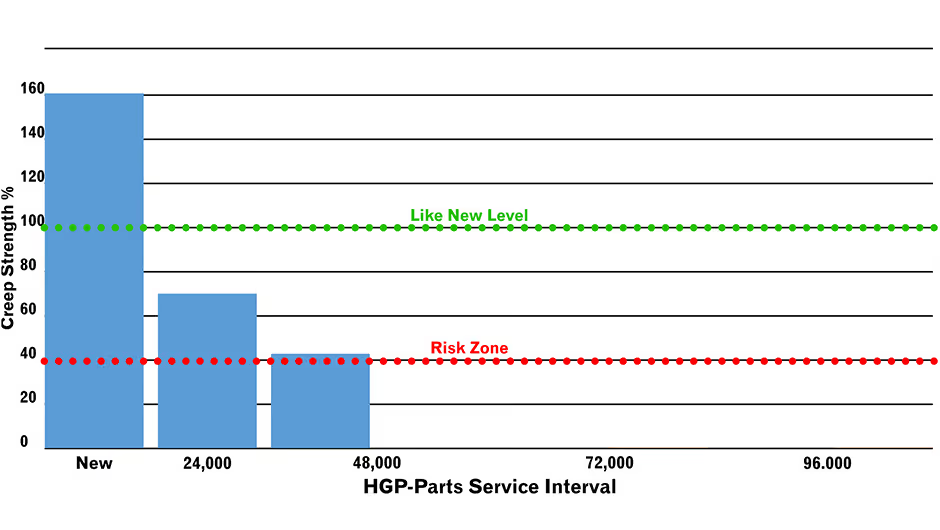
FSR® reverses microstructural degradation to restore alloy strength and extend the life of high-value blades.
There are two main phases:
Collapses internal creep voids in the alloy, re-densifying the blade’s microstructure.
Dissolves overaged γ′ and regrows precipitates to optimal size, recovering creep strength and ductility.
Figures 2 and 3 illustrate recovery of microstructure and properties at the microscopic level.
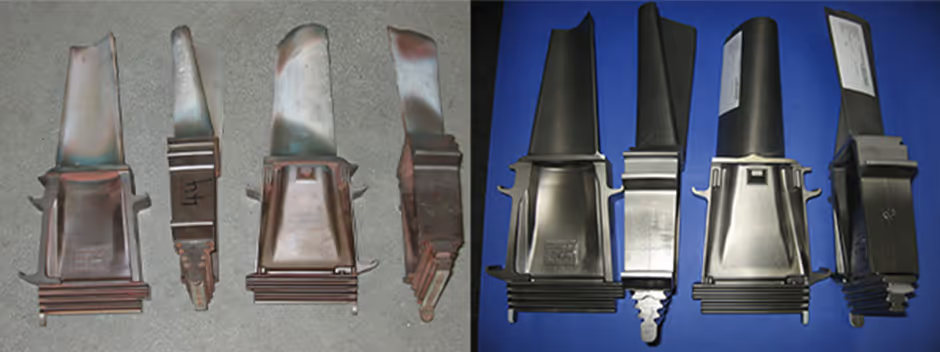
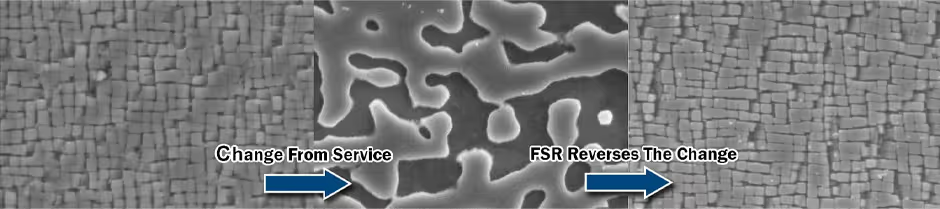
Microscopic voids and γ′ overaging drive strength loss. Applying FSR® at regular intervals restores creep strength, extends turbine blade life, and defers costly replacements. Figure 4 highlights the long-term benefit of FSR® compared to untreated components.

Broadly proven across a wide range of turbine blade applications.
Applicable with careful process control to avoid recrystallization; minimize cold work and verify via metallography.
External and internal coatings are stripped before FSR® and reapplied after heat treatment.
Minor stress-relief distortion is managed by repair sequencing, weld restoration, and finish machining.
Each program is controlled and validated through:
Stress-rupture testing is performed on representative material from the production set to confirm restored creep strength and life capability.
Microstructural analysis verifies precipitate size, distribution, and grain-boundary condition to ensure the alloy has been properly restored.
Time, temperature, and pressure are tightly controlled during HIP and subsequent heat treatments to ensure consistent, repeatable results.
Applied proactively, FSR® can save operators hundreds of thousands of dollars across the life of a set.
Planning a gas turbine blade repair or evaluating life-extension options? Our team can review alloy, run conditions, and inspection data to recommend an FSR® schedule.
Contact: info@liburditurbineservices.com