
Restore your gas turbine blades to OEM new-material specifications with Liburdi’s patented Full Solution Rejuvenation® (FSR®) process—extending blade life, reducing waste, and avoiding costly replacements.

Rising gas turbine blade replacement costs, long lead times, and wasted materials make every maintenance cycle more expensive. Many gas turbine blades are retired long before their material life is fully exhausted, forcing costly replacement and extended downtime.
Liburdi’s patented Full Solution Rejuvenation® (FSR®) process has restored more than 500,000 turbine blades across GE, Siemens, Westinghouse, Alstom, and Dresser-Rand platforms. By returning blades to OEM new-material specifications, FSR® helps operators avoid premature replacement and recover significant value from existing assets.
FSR® restores turbine blades to OEM new-material specifications, extending service life by two to three additional intervals. The result is lower replacement costs, reduced waste, improved asset utilization, and a proven alternative to purchasing new blades.

Extend blade life by two to three additional service intervals under typical operating conditions.

Restore existing blades to OEM specifications and avoid costly replacement purchases.

FSR® restores alloy microstructure and blade strength to OEM new-material specifications.
Liburdi's patented Full Solution Rejuvenation® (FSR®) process restores gas turbine blades by reversing the effects of long-term high-temperature exposure. Over time, critical alloy microstructures degrade through gamma prime coarsening, carbide degeneration, and grain boundary coarsening, reducing blade strength and limiting service life.
During FSR® processing, proprietary heat treatment cycles dissolve degraded gamma prime precipitates and reform them to their ideal size and distribution. This restores the alloy microstructure and mechanical properties to OEM new-material specifications.
Combined with precision stripping, coating replacement, and alloy-specific processing parameters, FSR® delivers reliable life extension, restored performance, and repeatable results across multiple service intervals.

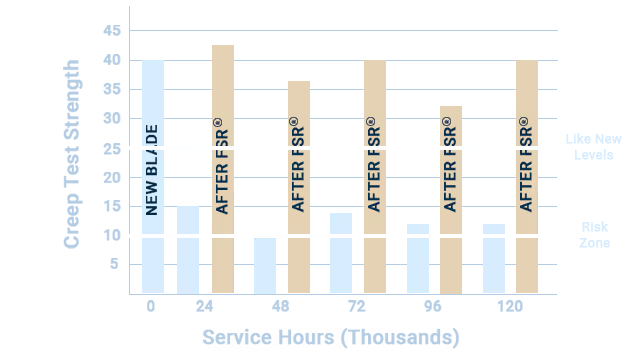
FSR®-processed blades are qualified using the ASTM E139 Stress-Rupture Test, the same standard used to evaluate new OEM components.
Test results verify restoration of creep strength and mechanical properties to OEM new-material specifications, supporting reliable performance across multiple service intervals.
Backed by more than 45 years of proven success, FSR® provides operators with a validated alternative to costly blade replacement.
Since 1979, Liburdi has helped operators extend gas turbine blade life through Full Solution Rejuvenation® (FSR®). With more than 45 years of proven field experience, FSR® has restored hundreds of thousands of blades across a wide range of gas turbine platforms.
Unlike conventional repair methods that provide only limited life extension, FSR® restores blades to OEM new-material specifications, allowing multiple rejuvenation cycles throughout a component's service life.
The result is a proven technology with documented performance exceeding 100,000 service hours, helping operators reduce replacement costs, extend asset life, and maximize value from existing components.

Hot Isostatic Pressing (HIP) uses high temperature and pressure to eliminate porosity in metal castings. When turbine blades return from service, small voids known as creep cavities can weaken the alloy. HIP closes these cavities, restoring casting integrity and improving long-term performance.
Different alloys require customized HIP cycles. Liburdi’s engineering team carefully designs, tests, and verifies each process to ensure safety and effectiveness. Every batch is validated through metallography and mechanical testing to confirm full process success.
Yes. Applying Full Solution Rejuvenation® (FSR®) at each major repair interval helps restore blades to OEM new-material specifications. Skipping a cycle may leave blades with reduced strength, increasing operational risk in the event of firing errors or impact damage. Best practice is to apply FSR® at every major repair interval to maintain full design strength, operational flexibility, and peace of mind.
The metallurgical aging and creep that occur during service are fully reversible through FSR®’s specialized heat treatments. The process can be safely repeated multiple times. In fact, record sets have achieved six rejuvenation cycles, accumulating close to 200,000 hours of service, demonstrating the true longevity of Liburdi’s gas turbine blade repair technology.